
This Accelerate! profile takes a step back from our alumni to introduce the Chair or The NZ Young Physicists’ Trust, Gavin Jennings. Gavin’s volunteered with IYPT in New Zealand for twenty years and has some strong opinions on the value IYPT brings to all students.
“There’s very little you can do in this modern world without physics being involved. Whether it’s energy, electricity, waves, water; physics is there. There are next to no jobs that you can do without physics being involved at some level.”
Gavin Jennings constantly champions this theme as head of the physics department at Auckland Grammar School.
A veteran educator who rebuilt his career after moving to Aotearoa New Zealand from the UK, Gavin is on a mission to spark interest in physics and help build teams for the International Young Physicists Tournament (IYPT), where there are no googleable answers, only deep thinking.
Gavin was head of physics and also head of high school science before he, his wife Hazel, and their two sons migrated to New Zealand. He joined the physics department of Auckland Grammar School, where he soon took charge of the International Cambridge examinations within the school.
Today, Gavin leads the largest physics department in New Zealand, overseeing 13 dedicated teachers and a student body that has made physics the school’s most popular option or elective.
His secret? Moving beyond the textbook and into solving physics problems that provide a good training to compete – and win – at the International Young Physicists Tournament (IYPT).
Gavin is the chief organiser of the local competitions for the New Zealand Young Physicists Trust (NZYPT), which he heads. The winners form the team that competes at the annual international tournament, also known as ‘The World Cup of Physics’. Last year, the Trust expanded its programme to start a physics academy that mentors students in physics and encourages them to compete in the local rounds that can land them in the team for IYPT.
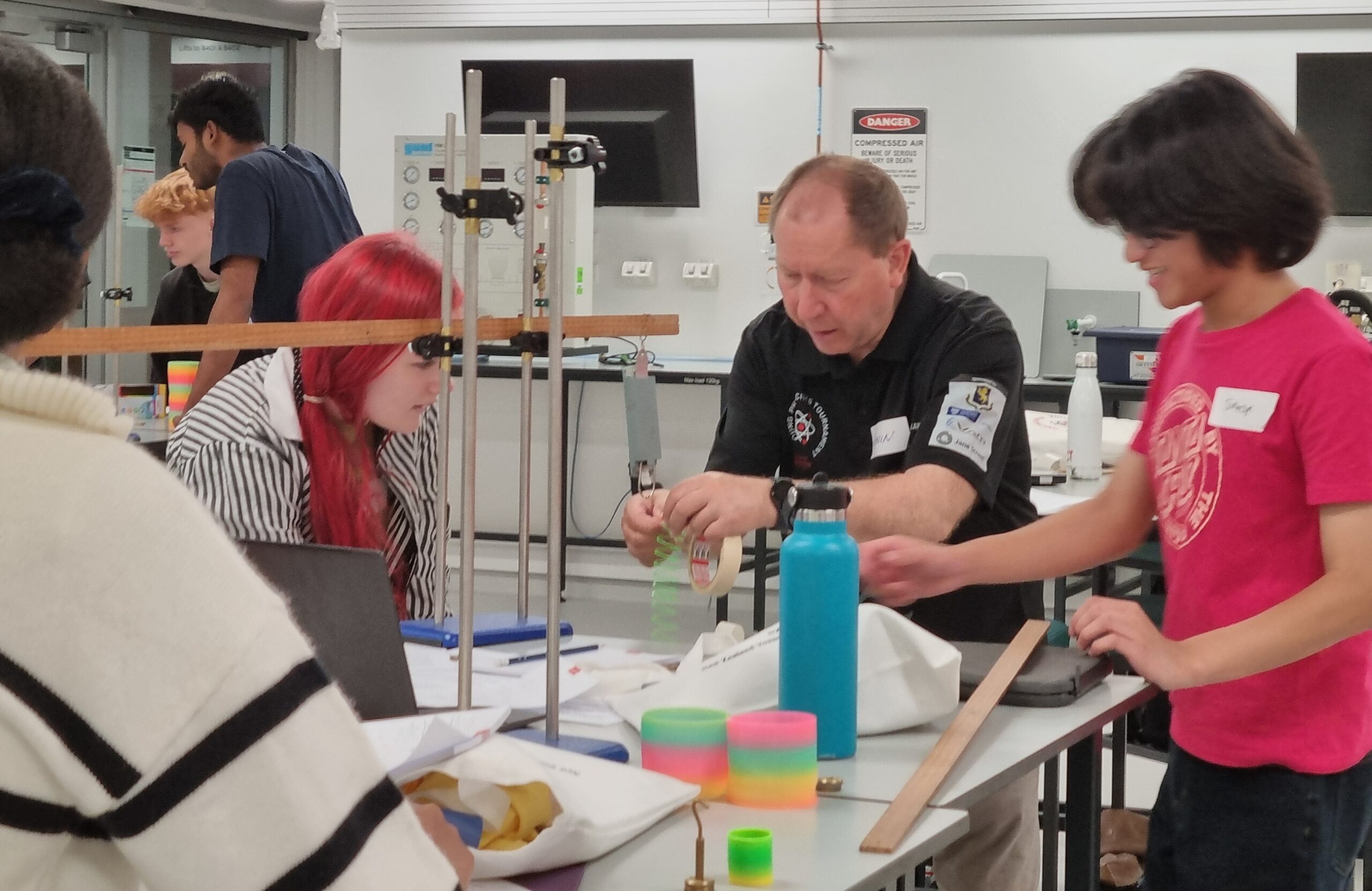
New Zealand is hosting the IYPT in 2027 in Auckland, a testament to two decades of leadership by Gavin and the NZ Young Physicists Trust, as well as the other physics teachers and volunteers who keep the competition going.
New Zealand has an exceptionally strong record in the tournament. Since first entering in 2003, New Zealand has frequently reached the top 15, including the ‘Golden Era’ where the team won four consecutive gold medals from 2007 to 2010, beating larger countries like China and Germany.
For Gavin, “It is important that when students leave school, regardless of what subject they go on and then study, they can at least have an appreciation of the understanding of the world around them.
“For me, the worst thing would be a physics student who leaves my lab at the end of the seventh form, the year 13, who will be a very competent physicist, passes exams, but has never actually thought about the subject, that deep thinking as to why, why does that work? That is why NZYPT and IYPT are so important. They encourage deep thinking.”
Setting sights on ‘The World Cup of Physics’
Gavin was at Auckland Grammar School for just over three years when one of the students told him about the International Young Physicists Tournament (IYPT). He went online that evening to research and found that unlike the Physics Olympiads, which he had been involved in, it was not exam-based. At IYPT, the teams get into a ‘Physics Fight’, where students carry out practical and theoretical research to solve a problem and then explain it in real-time before other students and judges. “That is a massive skill that is untapped by exams.”
He cites a recent project, where students made a Newton’s cradle. But it’s not a normal Newton’s cradle, “it’s made with magnets,” he says. “Students find that absolutely fascinating, you know, how’s it working. Is energy, is momentum being conserved? They go away and think about it and explain it to others.”
“This is new,” he says on how IYPT scores the students. “This is something that there are no answers to. You cannot Google it. Two people doing the same experiment can come up with two different, but equally valid, solutions.
“It just opens the door to problem solving approaches,” says Gavin. “As I say to the students on a regular basis, you know, why are you going to be paid the big bucks? You’re not going to be paid the big bucks because you know the answer, because someone else has told you it, you’re going to be paid the big bucks because you’re going to have to come up with a solution that works. And it could well be in the middle of COVID, in the middle of the geopolitical crisis at the minute, and the world financial crisis before that.
“These are things no one has ever had to encounter before. So, to come up with a valid solution, different teams will have to come up with different solutions. And they get to work with other people.
“They will reach out, and they will get specific help that they need to advance their skill set and advance the presentation of their project and take it to another level. They give the other person credit and cite them as a contributor. That’s how a real team works in industry, at university, across the world.”
The initial New Zealand teams at the IYPT were participated in by a single school. But from 2006 onwards, there was a New Zealand round to pick the team from different colleges.
Gavin became involved in administering the local competition in 2007, and joined the team in some of the competitions overseas. “It was great to be able to see other countries on the international stage, and then bring that information back to New Zealand to raise the standard of our competition as well.”
He says the problems given at IYPT are being used by schools even if they are not in the actual competition. IYPT’s rigorous requirements are in line with public exams criteria of allowing students to earn top-line credits while doing extracurricular work.
There are still schools, unfortunately, in New Zealand where physics is seen very much as a theoretical subject, says Gavin. “They learn it from a book. I think there has to be, obviously, book learning. But that has to be put in a context of the real world. Because physics equations are not perfect. There are always edge effects, other considerations that have to be thought out. And, again, practical work requires problem solving that students don’t get to do just on a written essay, or a written problem; and where there is one solution, and they’re expected to come to that answer.”
A 1970s Throwback: The Nuffield Physics Project
Gavin has been a science educator for over 40 years and says his interest in physics has been shaped by his own teachers’ commitment to inquiry based learning.
In high school, he became part of the Nuffield Physics project in 1970s Britain, which also covered other sciences like chemistry and biology. He explains that in class, rather than the teacher standing in front and saying, ‘I know everything, this is what you need to know, copy it down,’ they asked students to discover things for themselves. The teacher would say, for example, when we drop things, do they all fall at the same rate?”
“To have that mindset, then, it’s not enough just to read. Newton’s law of gravity says everything falls with the same acceleration. And then you think, well, it’s obviously wrong. If I drop something, like a feather, it doesn’t seem to work when compared to a stone.”
“So, do I trust the teacher? But then when you do it yourself, you find out that, wait a minute, it is true, but I’ve got to consider this other factor as well. Everything will start to fall in that way, but then other forces have to be considered.”
So how does this resonate in the AI era, when students can readily find information online? “There is a lot of factual content that does need to be learned, there is no doubt about that,” he says.
“But that is factual content, if you only consider just that one narrow line of train of thought. But where in life do you have that one simple train of thought where nothing branches in any way? As soon as it branches, you say, ‘wait a minute. I now have to know about these other things. And I have to see how they fit together. Because, again, there is more than one solution.’”
As Gavin looks back on his career, he says, “It’s been absolutely wonderful, being a physics educator, and a huge privilege to then take a team internationally as well.

“The students who compete at IYPT learn that it does not matter what country they studied in. They’ll quite often present their experiments, and find students from other countries had almost exactly the same ideas.
“It’s breaking down those barriers… People are having the same thoughts, dreaming up the same thing, all over the world. And, you know, to be a part of that, and helping build the next generation, has just been a real pleasure.”
As told to Divina Paredes