
For Teachers
IYPT provides 17 open-ended problems every year for students to investigate experimentally. Your students do not need to compete in IYPT to use the problems in the classroom or as project inspiration. All we ask is that IYPT is acknowledged as the source.
Why IYPT?
IYPT investigations reinforce the practical skills assessed in external examinations. Researching individual problems will reinforce and delve deeper into curriculum topics. Or introduce entirely new areas of physics. It is also fun!
- Many students find the practical work deepens their understanding of how forces interact and energy transfers. It has been known to change career aspirations as it did for alumnus Luke Roeven.
- Participating in IYPT gives students real-life research experience and acheivements to discuss in University entrance applications. It will show selectors their authentic resilience, problem solving and communication skills to help them stand out from the crowd.
Teacher Resources

Here are all 17 IYPT problems for 2027. The NZ team aims to develop solutions for 15 of them.

However for the New Zealand competitions we only use these seven of them.
School teams should aim to have developed solutions for at least three, and ideally five, problems for the schools’ Tournament.

The remainder of this page are frequently asked questions from teachers. Please contact us if you have another!
As a Teacher, what do I need to do?
Your role is that of mentor and facilitator. There is no formal teaching required and absolutely no lessons to plan. In fact, you need to do relatively little, although your students will find your support and encouragement invaluable.
Individual students applying to be in the rep team do not need to involve a teacher at all, although we will inform you if they complete their entry. Successful teams also have to be self-motivated and resourceful to work independently and outside of class time. For a school team of three students, you must:
- Ensure the team’s entry admin is correctly completed within the deadlines, and
- If your school is paying the entry fee, arrange to have it paid in line with your purchasing policies. The team fee in 2027 is $145 plus GST, and,
- Accompany your team (or arrange for a suitably qualified replacement) to the tournament and act as a juror on the day.
Many established NZYPT schools run a “Physics club” throughout the year to work on the problems. We offer mentoring to teachers new to the tournament. Contact us if this would be helpful.
What do my students need to do?
First, research one or two of the New Zealand problems between now and the relevant deadline. They can start as soon as they wish after the seven problems announced in August. (The 2027 problems were announced on August 15th.) There is a separate section of this website for Students that you might find helpful.
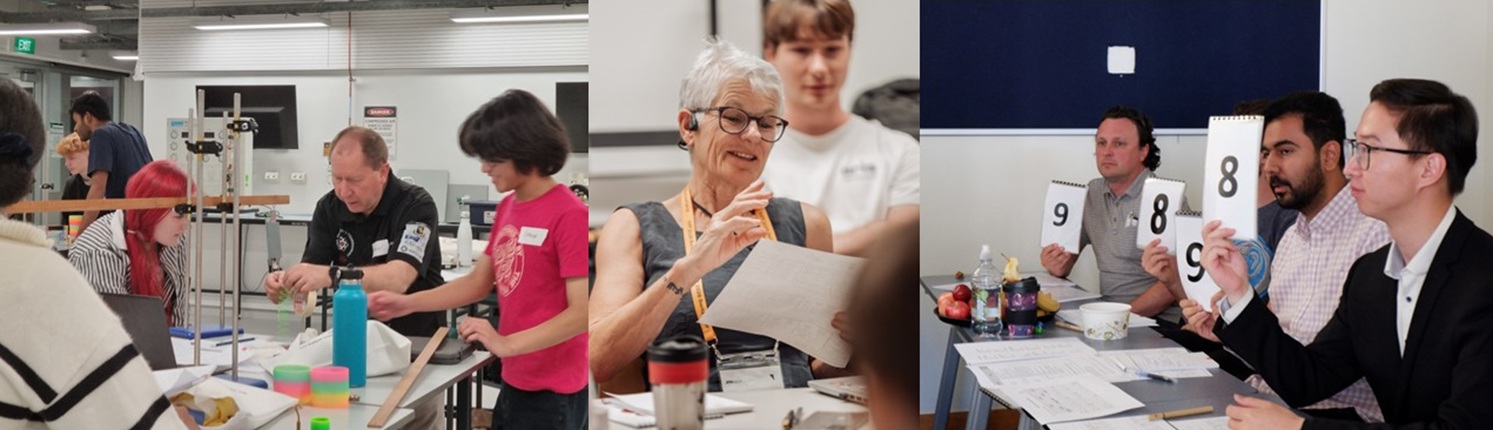
Then, at the team tournament, teams will present their research, and challenge that of opposing teams in a series of three physics ‘fights’ or matches. Each team needs about four solutions between them to do well.
Individuals only entering the rep team selection process need only have one solution prepared. They submit a video of their solution as the first step of the selection process.
What is a physics match?
A physics match is a very structured discussion of one team’s research into a problem, that is then questioned by a second team. Find the full explanation here.
What if I don’t know the answers?
We doubt you have ever studied in detail the phenomenon in the problems, so you probably will NOT know the answers. This is OK.
There are no right answers or complete solutions to these open-ended problems. Students must research phenomena and present their own conclusions in the tournament.
How many exams do students need to take?
None. This is NOT an examination based competition. Not least because nobody knows in advance what will be discovered. Students must research and present their own findings.
What if a team gets outside help?
That is all part of being resourceful. Getting outside help – from books, the internet, advice from experts, loan of equipment and facilities – is all part of getting a solution and it is encouraged!
However, in a Physics fight the team must present their solution to the problem and then defend it without internet access. If they don’t understand the solution they have just presented, or if they didn’t do the experimental work themselves, this is painfully obvious to the jury, and the team will score poorly.
Can students use AI?
Yes. Students may use AI for brainstorming and conceptual verification. However if they rely on the AI for data instead of experimenting, they will be found out in competition and loose marks. The best teams compare actual results with their theoratical prdictions and account for any differences.
A good solution presents lots of practical experimentation to get reliable data to illustrate (or not) relevant physics theory. Experiments don’t always work first time and may need refining. Real life has error bars!
What if my team faces a top team in the first round?
In a good match both the problem reporters and opponents score highly. You are not there to “beat the competition” in the debate. Teams that face good opponents usually score well in that same fight. Having good physics to question or defend brings out the best in both teams.
Who can compete?
All students attending a New Zealand secondary school throughout the year of the competition can take part. This includes students taking the odd tertiary paper but excludes those attending university full time. Usually, participants are working in Year 12 or 13 classes, just so they know enough physics to get started. But there are no age limits and in 2026 the team competition was won by a year 12 team.
NB: To be considered for the New Zealand representative team, students must be NZ citizens or residents.
Isn’t this a competition just for the occasional genius?
No. Students need to have learnt some advanced high school physics and during their research they will learn more. Genius however is definitely not required.
This is a competition which rewards resourcefulness, communication and scientific inquiry. Being brilliant at physics, on its own will not win a physics match. The need for teamwork, practical experiments, the ability to answer and debate questions “on your feet” (without internet access!) as well as having good problem-solving skills are key attributes for any student who wants to do well. The tournament aims to develop these skills that are so vital for STEM careers.